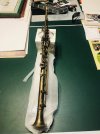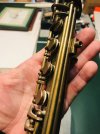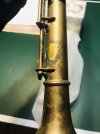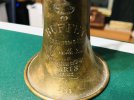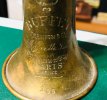

When I was a part of the 264th Army Band, Honolulu back in the early 1970's (they were deactivated Oct. 1974), we had a few older John Philip Souza march scores in our music library that had sarrusophone parts. Some of these parts were handed down from Army Bands that were no longer in service, I vaguely remember their copyrights before WW2 started. So
@Bchealth indeed has a rare bit of history in his hands.
The following brief historical explanation is given by Yandex A.I.:
The sarrusophone was invented in 1856 by Pierre-Louis Gautrot, who named it after the French bandmaster Pierre-Auguste Sarrus, who came up with the idea for the instrument. The sarrusophone was made to compete with the saxophone and to replace the oboes and bassoons in military bands. It was available in all sizes from Eb sopranino to BBb contrabass, including contrabasses in Eb, C, and Bb. 135
The sarrusophone enjoyed a burst of popularity in the early 1900s when a number of big-name composers, including Maurice Ravel, Frederick Delius, and Igor Stravinsky, wrote parts for it in a number of their compositions. However, nowadays, the unfamiliarity and unpopularity of sarrusophones means that these parts are more often than not taken by the contrabasson. 2
The production of the sarrusophone ceased in the 1930s. 1
Looks like the saxophones won out over the sarrusophones. I was transferred to the 25th Infantry Division Band, Wahiawa, Hawaii shortly after the 264th's deactivation. Being the ranking woodwind player as an E-5 (Specialist-5), I was made the woodwind section leader. We had a rag-tag group, a flutist, about 5 clarinet players including me, alto and tenor saxists, about 8 trumpet players, 5 trombonists, a baritone or two, 2 souzaphonists, couple french horns and a healthy number of percussionists.
We were brass heavy. I convinced all our clarinet players to play sax instead. Now, we had a decent saxophone choir. In marches, the saxes often carry the countermelodies. The flutes and clarinets do the fancy higher octave stuff for color, but are less essential. The brass carries the melody.
Now we had 2 - 1st altos, 2 - 2nd altos, 3 tenors, and 1 bari. The flute player agreed to play piccolo. To boost morale and increase our volume to "balance" the trumpets and trombones, I convinced our first sergeant (who was promoted shortly after to sergeant major - the top non-commissioned officer, top dog) to ask higher leadership above us to fund and provide us sax players with Berg-Larson jazz metal mouthpieces.
He was able to do that. Normally mouthpieces (we had our share of Brilharts and a few others) are considered expendable items due to plastic and hard rubber wear and tear, but these B-L's were hand receipted to each player for turn in upon leaving the unit, due to their high cost.
It worked. Our saxists were happy to receive the B-L mouthpieces. Our sergeant major (who was filling in for our retiring chief warrant-officer) was deeply pleased with our new sound as well as the higher leadership. It was immediately noticed outdoors in the field and parades.
Back to why the sarrosophone was obsoleted as a military instrument? I imagine it was probably because they did not have the volume output whereas the saxophone did. Double reed players are harder to come by. A clarinetist can easily transition to saxophone.
Perhaps someone with more intimate information on the sarrusophone can fill in.